
A federal program that deposits one thousand dollars into a child’s name should command the attention of every employer and every advisor. In our practice, it has not — not yet. The Trump Account arrived inside the One Big Beautiful Bill Act, and the headlines have been loud: free money for newborns. What the coverage has not addressed is how the account is taxed, who may contribute, what an employer may do with it, and what changes when the child reaches adulthood.
We are watching a launch that is no longer theoretical. Accounts open on July 4, 2026, and the Treasury Department has already begun activating accounts for families who filed their elections. For employers weighing whether to offer this as a benefit, and for advisors guiding clients through it, the window to prepare is measured in weeks, not quarters.
This is the first post in our series on the Trump Account under Internal Revenue Code Section 530A. Here, we lay out what the account is, how it is opened, the issues our clients ask about first, and what employers and advisors should do before the July 4 launch.
What the Trump Account Is
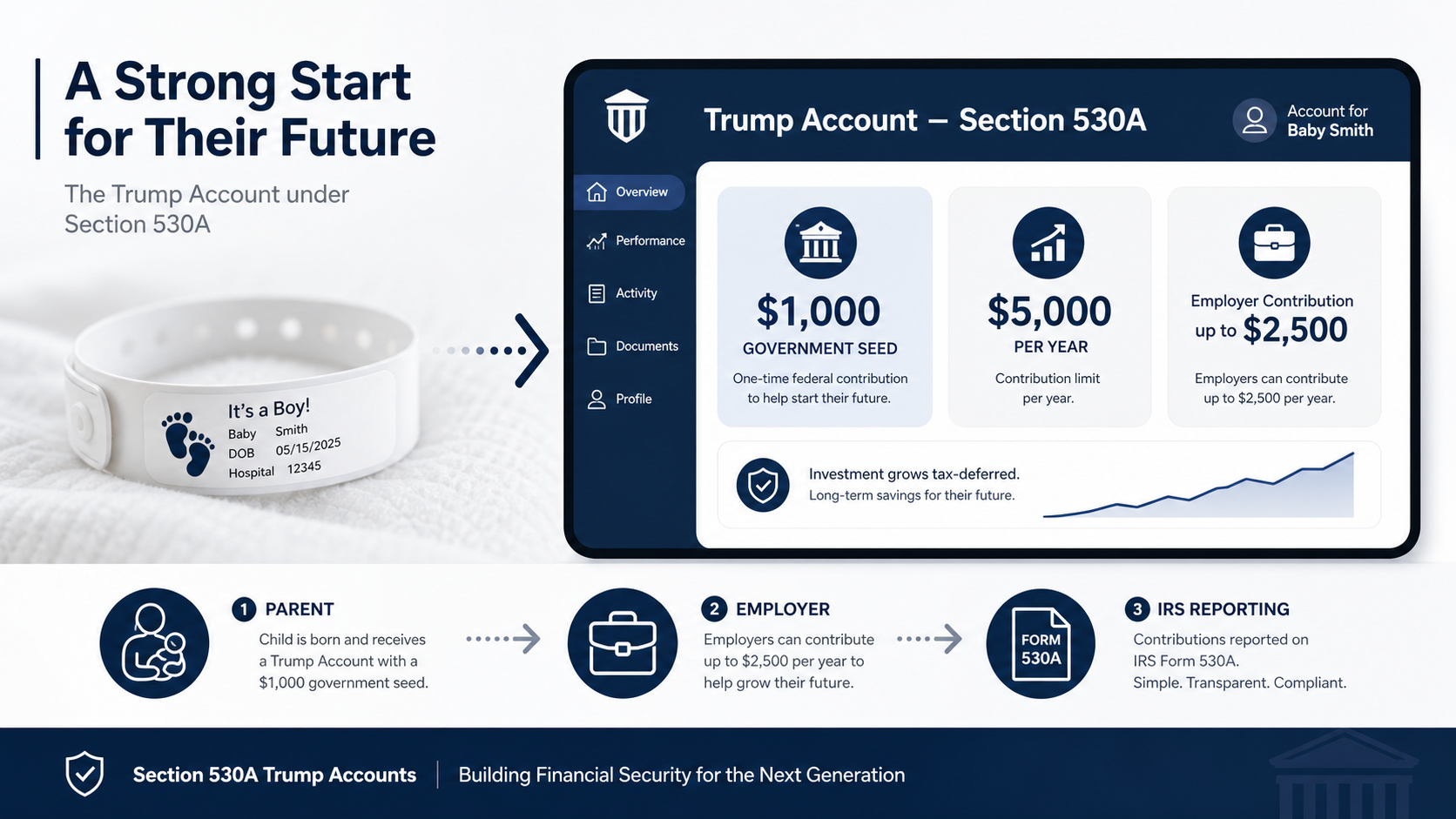
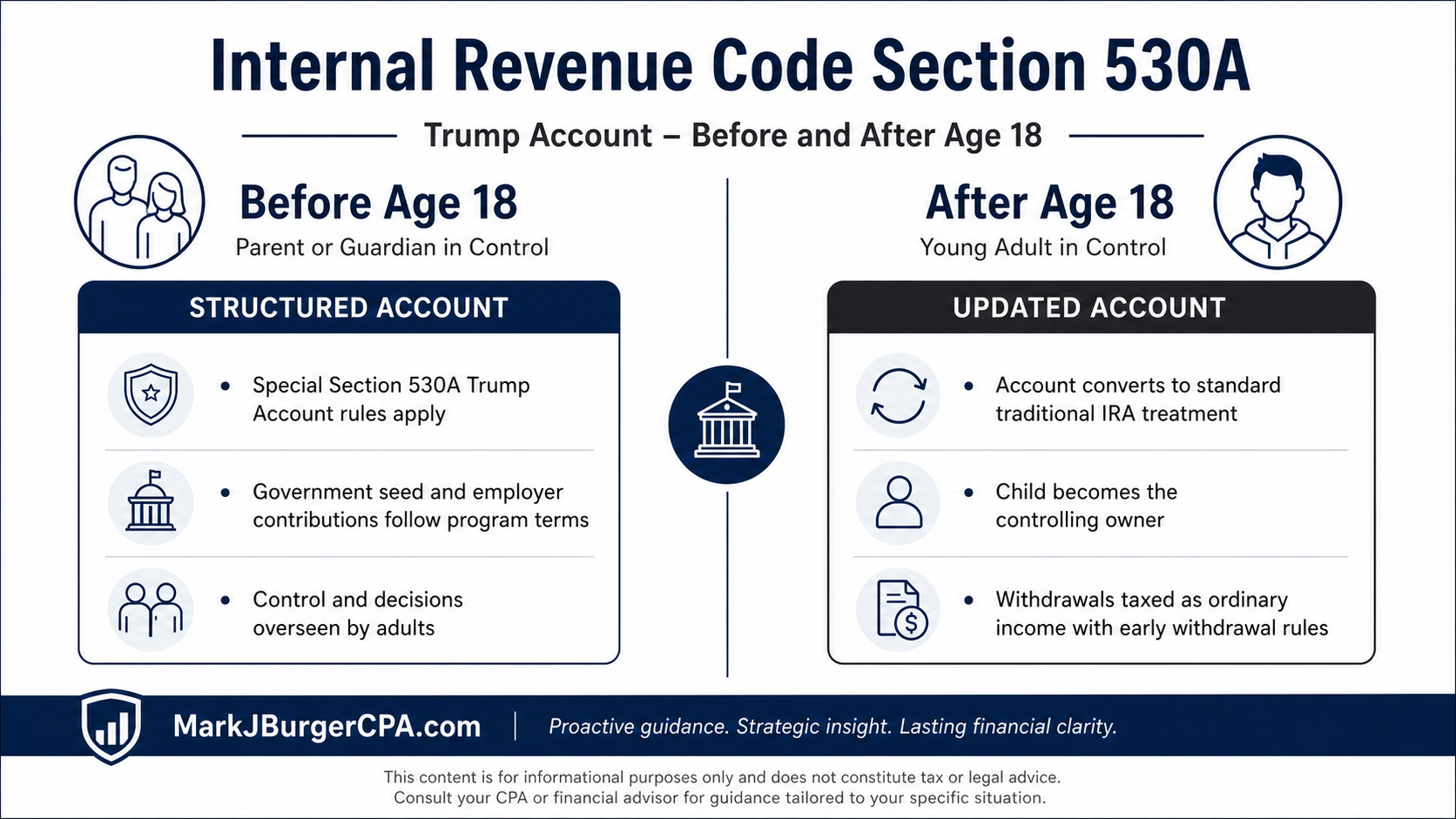
A Trump Account is a new type of traditional individual retirement account created for children under Section 530A of the Internal Revenue Code. Treasury establishes the account for the exclusive benefit of an eligible child, and the child is the owner. During the years before the child turns eighteen, the account follows special rules, and funds are generally invested in a qualifying United States index fund. When the child turns eighteen, those special rules fall away, and standard traditional IRA rules apply. Employers and advisors evaluating whether this fits into a broader benefits or tax planning strategy need to understand these mechanics before the July 4 launch, not after.
| Feature | Detail (current guidance) |
|---|---|
| Account type | Traditional IRA for a child under Section 530A; the child is the owner |
| Eligible child | United States citizen under age 18 with a valid Social Security number |
| Government seed | One-time $1,000 contribution for children born January 1, 2025, through December 31, 2028 |
| Annual limit | $5,000 per child from all sources combined, indexed after 2027 |
| Employer contribution | Up to $2,500 per employee per year, excluded from income, counted within the $5,000 limit |
| Launch | Accounts open July 4, 2026; no contributions are permitted before that date |
| How to open | File IRS Form 4547 with a tax return, or online at trumpaccounts.gov |
How an Account Is Opened
The mechanics are now defined. An authorized individual, such as a parent or guardian, opens the account by filing IRS Form 4547, Trump Account Election(s). The form may be filed with a federal income tax return or through the online portal at trumpaccounts.gov, and the same election requests the one-thousand-dollar pilot contribution for an eligible child.
Treasury has now launched the Trump Accounts application and begun account activation ahead of the July 4 launch. Families who already filed Form 4547 are receiving setup instructions in phases. No contribution may be made before July 4, 2026.
Regulatory status: The framework rests on IRS Notice 2025-68 and proposed regulations issued March 6, 2026. Several rules, including how employer contribution programs coordinate with Section 125 cafeteria plans, how nondiscrimination testing will apply, and how individual states will conform, remain in proposed or pending form. Guidance continues to evolve, and any account strategy should be confirmed against the most current released guidance.
The Employer Opportunity and Contribution Rules
The employer benefit is real, but it is technical. It runs through a dedicated program under new Section 128 of the Internal Revenue Code — not simply through an existing benefit plan an employer already sponsors. An employer may contribute up to $2,500 per employee per year, and that contribution is excluded from the employee’s income. It still counts within the child’s overall $5,000 annual limit, so an employer contribution reduces the room left for family contributions in that same year.
For employers considering this as a differentiated benefit — particularly those already working through business services engagements around compensation and benefits strategy — the opportunity is genuine. A benefit that deposits money directly into a child’s name is difficult to replicate with traditional perks, and it is structured correctly from the first contribution when the program is built with the Section 128 mechanics in mind rather than bolted onto an existing plan. Because the coordination between employer contribution programs and Section 125 cafeteria plans is still in proposed regulatory form, we recommend employers confirm plan design against current guidance before committing to a contribution structure.
The Key Issues Our Advisory Practice Sees
This is where most coverage stops and where advisory work begins. The account is simple to open and complicated to use well.
- → Taxation is not free. Contributions are not deductible, and distributions are taxed as ordinary income, with a possible additional tax before age 59½.
- → The employer benefit is real but technical. It runs through a dedicated program under new Section 128, not simply through existing benefit plans.
- → Basis is not uniform. The seed, employer dollars, and family dollars do not share the same tax treatment, which affects what is taxed at withdrawal.
- → The age-eighteen transition changes the rules. Control passes to the child, and the account converts to standard IRA treatment.
- → Coordination is required. The account interacts with 529 plans, custodial accounts, financial aid, and state tax law, and not always favorably.
Each of these feels like a detail. Collectively, they determine whether the account builds wealth or creates a quiet liability. A parent can read the headline in a minute. But no headline shows the tax at withdrawal, the basis that must be tracked, or the compliance obligations an employer assumes when it funds an account.

Coordinating the Trump Account With Existing Planning
The Trump Account does not exist in isolation. Most of the families and business owners we work with already have a 529 plan, a custodial account, or a broader wealth management strategy in place for a child’s future. The Trump Account has to be layered into that picture, not treated as a replacement for it.
The coordination questions are not academic. A traditional IRA-style account owned by a child can affect financial aid calculations differently than a 529 plan or a custodial account does. State tax treatment of contributions and growth is still being worked out jurisdiction by jurisdiction. And because the account converts to a standard IRA at age eighteen, the family’s plan for the account needs to account for a young adult gaining full control of the funds — not just the accumulation years leading up to that point.
What This Means Before July 4
The barrier is not awareness. It is interpretation. The Trump Account is not a giveaway to be claimed. It is a planning vehicle to be understood. The work is not to react to the headline. It is to prepare before the launch.
- → Employers gain a differentiated benefit, structured correctly from the first contribution.
- → Advisors gain a framework to guide families through eighteen years of decisions.
The accounts that are understood early will compound for decades. The accounts that are opened without a plan will reveal their costs slowly. This series will examine the Trump Account as employers and advisors must see it: the structure and key issues covered here, the employer opportunity to build a tax-favored benefit, the sources of contribution and their effect on basis and taxation, and the long accumulation that ends when the child turns eighteen.

37 years advising employers. Independent, employer-side perspective. Full transparency on any compensation. If you are an employer weighing whether to offer the Trump Account as a benefit, or a parent trying to understand what it means for your child’s future, we welcome the conversation. Contact our office to discuss how Section 530A fits into your broader tax and financial picture.
Regulatory references: One Big Beautiful Bill Act (Pub. L. 119-21); IRC Sections 530A, 128, and 6434; IRS Notice 2025-68; proposed regulations (IR-2026-33, March 6, 2026); IRS Form 4547 and instructions; U.S. Treasury Trump Accounts announcements (2026).
Trump Account FAQ

- What is a Trump Account? A Trump Account is a new type of traditional IRA created under Internal Revenue Code Section 530A for children under age 18. Treasury establishes the account for the exclusive benefit of an eligible child, who is the account owner. Funds are generally invested in a qualifying U.S. index fund until the child turns eighteen, when standard traditional IRA rules take over.
- Who qualifies for a Trump Account? An eligible child must be a United States citizen under age 18 with a valid Social Security number. Children born between January 1, 2025, and December 31, 2028, also qualify for a one-time $1,000 government seed contribution. An authorized individual, such as a parent or guardian, opens the account on the child’s behalf.
- When do Trump Accounts launch, and when can contributions be made? Trump Accounts open on July 4, 2026. No contributions of any kind, including the $1,000 government seed, may be made before that date. The Treasury Department has already begun activating accounts in phases for families who filed IRS Form 4547 in advance of the launch.
- How much can be contributed to a Trump Account each year? The combined annual contribution limit is $5,000 per child from all sources, indexed for inflation after 2027. Within that limit, an employer may contribute up to $2,500 per employee per year, and that employer contribution is excluded from the employee’s income. Contributions themselves are not tax-deductible.
- How do employers contribute to a Trump Account, and is it taxable? Employers may contribute up to $2,500 per employee per year through a dedicated program under new Internal Revenue Code Section 128, not through existing benefit plans. The contribution is excluded from the employee’s income but still counts toward the child’s overall $5,000 annual limit. Coordination with Section 125 cafeteria plans remains in proposed guidance.
- How is a Trump Account taxed at withdrawal? Contributions to a Trump Account are not tax-deductible, and distributions are taxed as ordinary income. An additional tax may apply to distributions taken before age 59½, similar to a traditional IRA. Because the government seed, employer dollars, and family dollars carry different basis treatment, tracking basis matters for the eventual tax bill.
- How do I open a Trump Account? An authorized individual, typically a parent or guardian, opens a Trump Account by filing IRS Form 4547, Trump Account Election(s). The form can be filed with a federal income tax return or submitted online at trumpaccounts.gov, and the same election requests the one-time $1,000 pilot contribution for an eligible child.
This article provides general information about Trump Account and Section 530A planning strategies and should not be construed as specific tax advice. Tax laws are complex and subject to change. Individual circumstances vary significantly, and what works for one taxpayer may not be appropriate for another. We recommend working with qualified tax and financial advisors to develop a strategy tailored to your specific situation. This content does not constitute an offer of advisory services and is provided for informational purposes only.