

News, Insights & Updates
Stay informed with the news, business, tax, and financial developments that matter to your bottom line. Mark J. Burger, CPA analyzes the industry trends, regulatory changes, and strategic opportunities that bear on client decisions.
I write regularly on:
- Tax law changes and their practical impact on your business operations
- Economic trends affecting specific industries across New Hampshire and Florida
- Strategic opportunities for business growth and optimization
- Legislative updates relevant to business owners and executives
- Best practices for financial management and operational efficiency
Whether you are an established business owner or growing your enterprise, this analysis is written to help you navigate a complex landscape with confidence. Bookmark this page and check back regularly for new insights that can give your business a competitive edge.
Click to Learn More:
- The Trump Account at Eighteen: Accumulation, Control, and the Value That Survives the Tax
 The account that begins with a free thousand dollars does not end with one — it ends with a decision, and the decision belongs to an eighteen-year-old. Here is what eighteen years can realistically build, what changes the day control passes to the child, and the value that survives the tax.
 - The Dollar That Gets Taxed Twice: Sources, Basis, and Taxation Inside a Trump Account
 Two dollars can sit side by side in the same Trump Account — one taxed at withdrawal, one that isn’t. Here is how the five contribution sources decide the tax, and why the records matter more than the balance.
 - How Employers Build a Tax-Free Retention Advantage with Trump Accounts
 Employers can now contribute up to $2,500 per employee to a Trump Account, tax-free, under new Section 128. The rules are simple. The structure most employers will get wrong is not.
 - Internal Revenue Code Section 530A (“Trump Accounts”): The Essential Guide for Employers
 A federal program that deposits one thousand dollars into a child’s name should command every employer’s attention. Here is what the Trump Account under Section 530A actually requires before the July 4, 2026 launch.
 - A CPA Advisor Provides Governance Value in a PEO Relationship
 PEO Governance: The Missing Discipline in Co-Employment RelationshipsPost 5 of the PEO Governance Series | Final Post But throughout this series, one question has been present beneath every framework, every dashboard, and every warning sign: Who is actually going to do this? The PEO will not govern itself. It is the service provider. The broker who placed the PEO has a financial relationship with the provider. Internal HR may lack the financial depth. The CFO may lack the co-employment expertise. And the business owner is focused on running the business. This is the… Read more: A CPA Advisor Provides Governance Value in a PEO Relationship
 - 12 Devastating PEO Warning Signs Most Employers Never Detect
 PEO Governance: Warnings and The Missing Discipline in Co-Employment Relationships Post 4 of the PEO Governance Series Misalignment shows up six to eighteen months before most owners recognize it. The signals are there. They surface in operational patterns, financial trends, team behaviors, and leadership assumptions. They are rarely dramatic. They do not arrive as crises. They arrive as small, easily dismissed observations that accumulate until a triggering event — a renewal increase, a compliance failure, a key employee departure — forces the conversation that should have happened three quarters earlier. This post identifies… Read more: 12 Devastating PEO Warning Signs Most Employers Never Detect
 - Bulletproof Your PEO: The Proven Governance Blueprint for Smart Employers
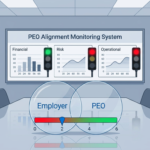 PEO Governance: The Missing Discipline in Co-Employment Relationships – Post 3 of the PEO Governance Series Understanding those principles is essential. But understanding without implementation changes nothing. Governance requires structure. Structure requires a system. This post delivers the system. A practical, implementable framework we recommend to clients — one that transforms PEO oversight from passive assumption into active, measurable discipline. And the timing matters. The 2025-2026 regulatory environment has introduced an unusually dense wave of changes that directly impact PEO operations: new federal payroll withholding rules under the One Big Beautiful Bill Act,… Read more: Bulletproof Your PEO: The Proven Governance Blueprint for Smart Employers
 - Six PEO Governance Gaps Unmasked — And the Proven Framework to Eliminate Them
 PEO Governance: The Missing Discipline in Co-Employment Relationships Post 2 of the PEO Governance Series The result is passive outsourcing — a co-employment relationship running on autopilot while costs drift, risk exposure shifts, and the HR model falls out of alignment with the company’s growth trajectory. This post addresses the next question: if governance is the missing discipline, where exactly does it need to live? PEO Governance lives in six core domains. If your leadership team is not reviewing these areas on a quarterly cadence, you are not governing the relationship. You are… Read more: Six PEO Governance Gaps Unmasked — And the Proven Framework to Eliminate Them
 - PEO Governance: The Hidden Discipline That Protects Your Bottom LinePEO Governance: The Missing Discipline in Co-Employment RelationshipsPost 1 of the PEO Governance Series Then the contract is signed. Onboarding is completed. Payroll begins to run. And the oversight stops. A PEO is not simply a vendor. It is a co-employment structure. The PEO becomes the employer of record for tax and benefits purposes. It assumes specific responsibilities for payroll processing, regulatory compliance, workers’ compensation administration, and employee benefits management. That level of operational integration demands more than a handshake and an annual renewal review. Co-employment without governance creates drift — financially, operationally,… Read more: PEO Governance: The Hidden Discipline That Protects Your Bottom Line
- Protect Family Wealth: How to Allocate the New $15 Million GST Exemption to Non-Exempt Trusts
 Executive Summary GST Exemption provided in The One Big Beautiful Bill Act, signed into law on July 4, 2025, has fundamentally altered the estate planning landscape. While many advisors have focused on the elimination of the TCJA sunset provisions, a more nuanced opportunity exists for families with existing non-GST exempt trusts. The permanent increase in the generation-skipping transfer (GST) exemption to $15 million per individual in 2026 creates strategic possibilities that warrant immediate attention. This analysis examines techniques for allocating GST exemption to trusts that were previously established without such protection, including late… Read more: Protect Family Wealth: How to Allocate the New $15 Million GST Exemption to Non-Exempt Trusts
 - Roth Conversion: Proven Strategies to Protect Your Retirement, Maximize the $6,000 Senior Deduction, and Avoid Catastrophic NIIT Penalties Forever (2025-2028)
 Roth Conversion Strategies. The One Big Beautiful Bill Act signed into law in July 2025 has created a four-year window for senior taxpayers to execute sophisticated Roth conversion strategies. For those age 65 and older, the new $6,000 additional deduction per individual (effective for tax years 2025 through 2028) presents an opportunity to manage conversion income, control net investment income tax exposure, and optimize effective tax rates in ways we have not seen before. We are currently in November 2025, which means there are approximately six weeks remaining to execute conversions that qualify… Read more: Roth Conversion: Proven Strategies to Protect Your Retirement, Maximize the $6,000 Senior Deduction, and Avoid Catastrophic NIIT Penalties Forever (2025-2028)