
PEO Governance: The Missing Discipline in Co-Employment Relationships
Post 2 of the PEO Governance Series
PEO Governance without structure is not governance. It is hope.
- And hope is not a risk management strategy.
- Not when your payroll, your compliance, and your employee relationships run through a co-employer.
- Where Are the Hidden PEO Governance Gaps Draining Your Business.
In the first post of this series, we established a foundational principle: most small and mid-size businesses evaluate their PEO carefully before signing, then stop governing the relationship entirely. Invoices get paid without review. Claims get reported without analysis. Service quality shifts without discussion. Strategic alignment erodes without anyone noticing.
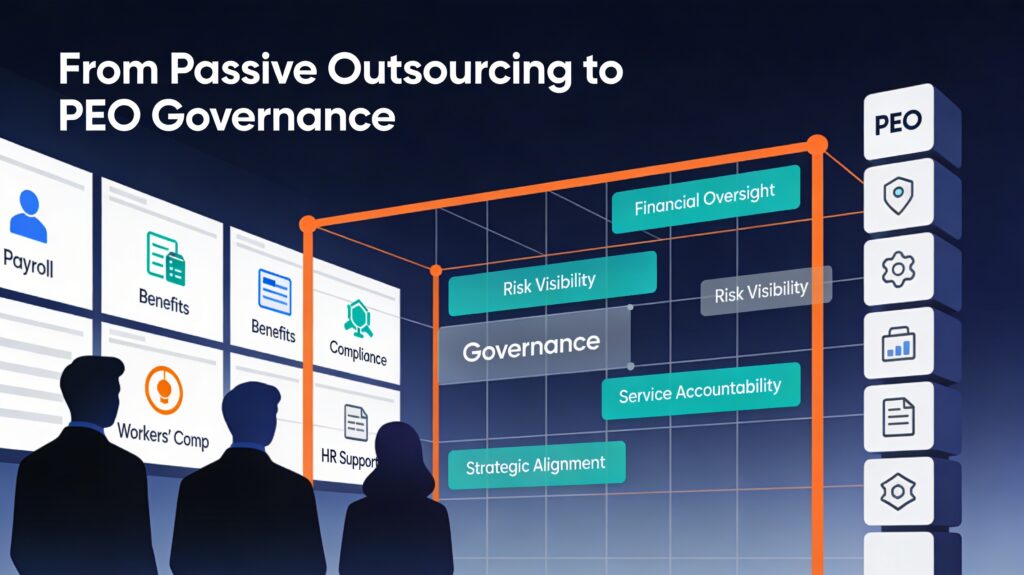
The result is passive outsourcing — a co-employment relationship running on autopilot while costs drift, risk exposure shifts, and the HR model falls out of alignment with the company’s growth trajectory.
This post addresses the next question: if governance is the missing discipline, where exactly does it need to live?
PEO Governance lives in six core domains.
If your leadership team is not reviewing these areas on a quarterly cadence, you are not governing the relationship. You are assuming it is working. And assumption is where hidden costs take root.
Domain 1: PEO Financial Governance
Financial governance is where most PEO oversight failures begin — not because the numbers are hidden, but because no one is asking the right questions at the right frequency.
A PEO invoice is not a simple line item. It is a composite of administrative fees, benefits costs, workers’ compensation premiums, payroll taxes, and technology charges. Each component moves independently. Each one can drift without triggering an alert.
The questions that financial governance demands on a quarterly basis:
- Is total PEO cost aligned with revenue growth?
- Can we explain every component of the invoice — not just the total?
- Is workers’ compensation trending appropriately relative to payroll and claims history?
- Are renewal increases supported by data, or are they presented as non-negotiable?
Most finance teams can tell you what they paid last month. Few can explain what changed from the month before, or why. Fewer still can identify whether cost increases are driven by claims experience, carrier repricing, administrative fee adjustments, or a combination of all three.
Early Signal: If your finance team cannot clearly explain what changed month-over-month in PEO costs, financial governance is weak. And weak financial governance is where renewal shock begins — twelve months before the renewal invoice ever arrives.
Domain 2: Risk Governance
Co-employment creates a shared risk environment. The PEO assumes certain employer responsibilities. The client company retains others. And in between those two spheres, ambiguity lives.
Risk governance is the discipline of monitoring where exposure actually sits — not where the contract says it should sit, but where day-to-day operations have placed it.
The questions that risk governance demands:
- Are workers’ compensation claims increasing in frequency or severity?
- Is Employment Practices Liability Insurance coverage sufficient for current operations?
- Who owns workplace investigations — the PEO, or the client company?
- Are managers properly trained on documentation, discipline, and termination procedures?
Risk governance failures rarely announce themselves. They surface as patterns. Claims frequency creeps upward. An investigation gets mishandled because ownership was unclear. A manager avoids a difficult conversation because they believe the PEO’s HR team will handle it.
Early Signal: Managers begin avoiding discipline and documentation because they assume “HR handles that.” That is not delegation. That is authority drift. And authority drift in a co-employment model creates liability gaps that neither the PEO nor the employer may be positioned to defend.
Domain 3: PEO Strategic Alignment Governance
A PEO model that was structured for a 40-person, single-state operation does not automatically serve a 150-person company expanding into five states with an acquisition on the horizon. But without governance, leadership assumes the model scales because no one has tested the assumption.
Strategic alignment governance asks whether the PEO relationship still supports the direction the company is actually heading — not the direction it was heading when the contract was signed.
- Does the PEO support our current and projected hiring strategy?
- Can it handle multi-state growth, including jurisdictions with complex employment law?
- Are benefit offerings competitive in the labor markets where we are recruiting?
- Does the PEO model support acquisition integration or does it create friction?
Strategic misalignment is the most expensive governance failure because it compounds silently over time. The company evolves. The PEO model does not. And the gap between what the business needs and what the PEO delivers widens with every quarter of unexamined assumptions.
Early Signal: Leadership says, “Our benefits are not helping us recruit.” That statement is not a benefits problem. It is a governance problem. It means the PEO relationship has fallen out of alignment with the company’s talent strategy, and no one detected the drift.
Domain 4: Operational Governance
Operational governance monitors the daily execution of the PEO relationship — the service delivery, responsiveness, accuracy, and consistency that leadership rarely examines until something visibly breaks.
PEO service quality does not collapse overnight. It erodes. A dedicated service representative leaves and is replaced by a shared team. Response times lengthen incrementally. Payroll corrections become more frequent. Onboarding processes that once ran smoothly begin generating complaints.
- Has service consistency declined since onboarding?
- Are payroll corrections increasing in frequency?
- Is response time from the PEO service team slowing?
- Is employee onboarding running smoothly, or generating friction?
Operational governance requires tracking these metrics over time, not just reacting when they become visible problems. A single payroll correction is an error. A pattern of payroll corrections is a system failure. The difference between the two is governance.
Early Signal: Managers begin bypassing the PEO system — handling issues directly, creating workarounds, or simply stopping the use of tools and processes the PEO provides. That is not initiative. That is a signal that the operational foundation of the relationship is degrading.
Domain 5: Cultural Governance
Co-employment creates a structural reality that most employees do not fully understand. They have an employer. They also have a co-employer. Policies come from one entity. Benefits administration comes from another. Payroll carries one company’s name. HR guidance may carry a different one.
Cultural governance ensures that the co-employment structure does not create confusion, undermine trust, or erode the employer’s relationship with its own workforce.
- Do employees clearly understand reporting lines and authority structures?
- Is it clear who sets policy versus who administers it?
- Does the co-employment model create confusion about who employees work for?
Cultural governance is the domain most businesses overlook entirely. It does not appear on any invoice. It does not show up in claims data. But when employees receive conflicting guidance from their employer and their PEO, or when they do not understand who holds authority over workplace decisions, trust erodes in ways that directly impact retention, engagement, and productivity. Learn more: Strategic Co-Employment: Supporting Long-Term Success for Growth
Early Signal: Employees say, “HR told me something different.” That single statement reveals a governance gap. It means the co-employment structure has created competing sources of authority, and the employee is caught between them.
Domain 6: Exit and Contingency Governance
No PEO relationship should be assumed permanent. Market conditions change. The company’s needs evolve. Service quality may decline. A better-aligned provider may emerge. Or the company may reach a scale where bringing HR operations in-house becomes the right strategic decision.
Exit and contingency governance ensures that the company can make that transition cleanly, without operational disruption, data loss, or contractual penalties that were never anticipated.
- Could we exit this PEO relationship cleanly within the contract’s notice provisions?
- Do we have access to and ownership of all employee data, payroll records, and compliance documentation?
- Do we fully understand the termination provisions, including any financial penalties or transition obligations?
- Is there a contingency plan if the PEO experiences financial distress or regulatory action?
Exit governance is not about planning to leave. It is about ensuring that the option to leave remains viable. A PEO relationship where the client cannot exit without significant operational disruption is not a partnership. It is a dependency.
Early Signal: Leadership does not know the notice requirements, data ownership provisions, or financial implications of ending the PEO relationship. That is not an oversight. That is a governance failure that reduces the company’s negotiating leverage at every renewal.
The Discipline Behind the Domains
Six domains. Each one is specific. Each one is measurable. And each one requires a structured cadence of review that most small and mid-size businesses have never implemented.
- Financial governance prevents renewal shock.
- Risk governance prevents liability surprises.
- Strategic alignment governance prevents the model from falling behind the business.
- Operational governance prevents service erosion from becoming invisible.
- Cultural governance prevents co-employment confusion from undermining trust.
- Exit governance prevents dependency from replacing partnership.
None of these domains govern themselves.
If your leadership team is not reviewing each domain quarterly, the relationship is not governed. It is running on the assumption that what was true at signing remains true today.
That assumption is where every hidden cost, every compliance gap, and every strategic misalignment begins.
The cost of governance is measured in hours. The cost of its absence is measured in exposure, lost leverage, and decisions made too late to correct without consequence.
Explore our full PEO advisory resources: PEOAdvisor.com
Explore Mark J Burger CPA’s areas of Practice
Coming Next: In the next post in this series, we will build a practical governance system you can implement immediately — a quarterly review framework with specific questions, metrics, and escalation triggers for each of the six domains.
- How do we practically set up a quarterly governance process for these six domains, and who on the leadership team should own each one? A practical quarterly governance process starts with assigning clear ownership for each domain: finance should own financial governance, HR (often with legal support) should own risk and cultural governance, the CEO or COO should own strategic alignment, operations or HR should own operational governance, and the CEO/COO with finance should own exit and contingency planning, with all of them reporting into a single quarterly PEO review meeting that uses the six domains as the standing agenda.
- What specific metrics or reports (dashboards, invoice details, claims data) should we request from our PEO to monitor these domains effectively, rather than just asking high-level questions ? To monitor these domains effectively, you should request detailed PEO invoices broken down by component (administrative fees, taxes, benefits, workers’ compensation), loss runs and claim trend reports, EPLI and coverage summaries, service-level or ticket/response time reports, payroll correction logs, onboarding metrics, and any available employee feedback or survey data that can highlight confusion or mistrust related to co-employment.
- If we discover serious issues in one or more domains (for example, rising costs or authority drift), what immediate steps should we take with our current PEO before considering an exit or provider change ? If serious issues emerge in one or more domains, the first step is to document the issues with specific examples and data, then formally raise them with your PEO through a structured review meeting, setting clear expectations, time-bound corrective actions, and escalation paths; only if the PEO cannot or will not address these gaps should you begin quietly evaluating alternative providers and updating your exit/transition plan so that, if you do move, you can do so on your timeline rather than the PEO’s.