
The account that begins with a free thousand dollars does not end with one. It ends with a decision — and the decision belongs to an eighteen-year-old.
For eighteen years, the Trump Account is governed by rules. Contributions are capped, investments are restricted, and withdrawals are largely locked. Then, on January 1 of the year the child turns eighteen, the rules end, and a young adult inherits both the balance and the choices that come with it.
This is the fourth and final post in our series on the Trump Account under Internal Revenue Code Section 530A. The first article covered what the account is and how it is opened; the second examined the employer’s Section 128 contribution; the third walked through how each contribution source is taxed. Here, we bring the series to where it has been heading: what eighteen years can realistically build, what changes the day control passes to the child, and the value that survives the tax.
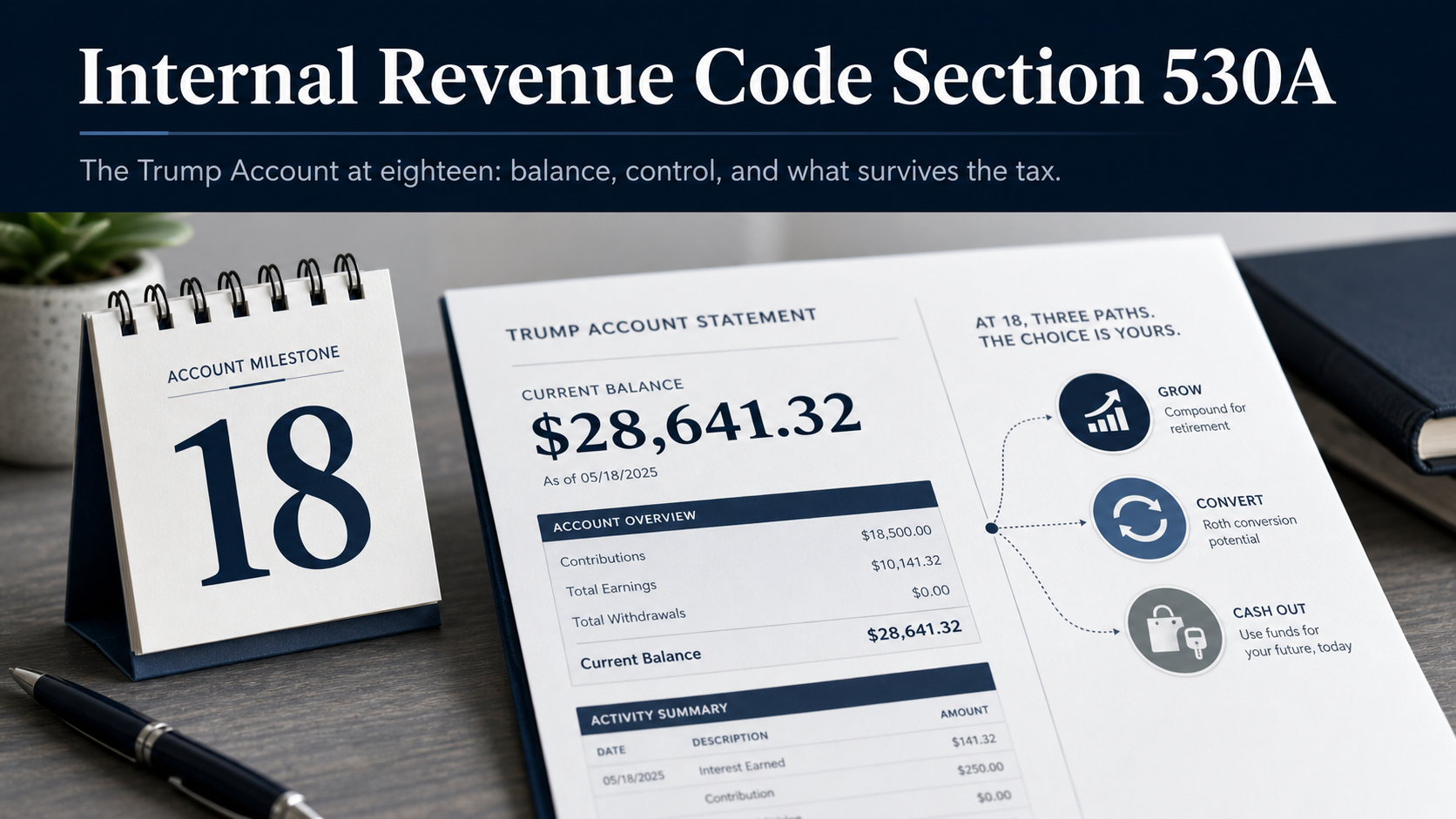
What Eighteen Years Can Build
Start with the seed and let it compound. Add modest contributions, and the numbers grow quickly. The government’s projections are striking, and they deserve a careful eye.
| Contribution scenario | Illustrative value at age 18 |
|---|---|
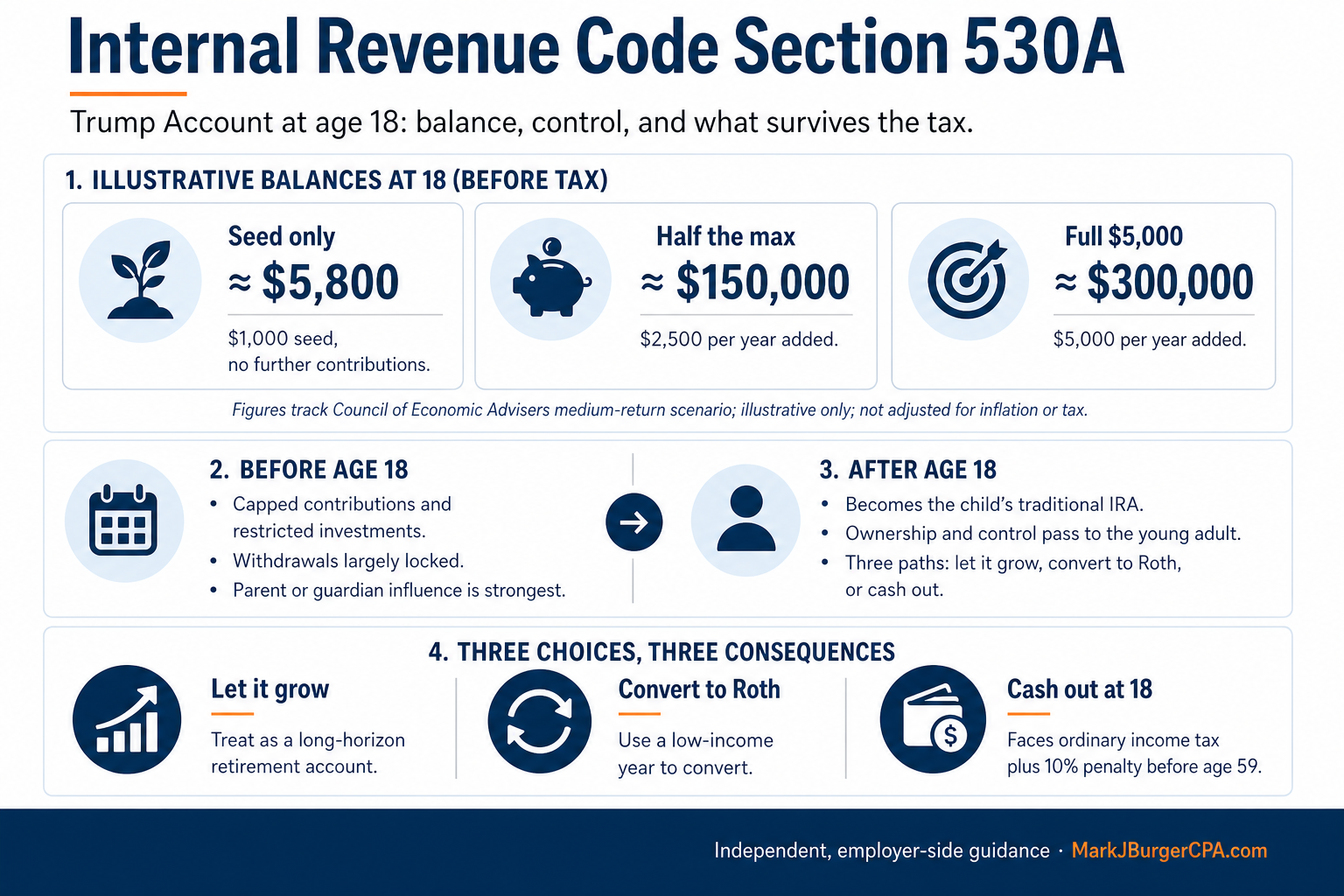
| The $1,000 seed only, no further contributions | About $5,800 |
| $2,500 added each year (half the maximum) | About $150,000 |
| $5,000 added each year (the annual maximum) | About $300,000 |
These figures track the Council of Economic Advisers medium-return scenario. They are illustrative only. They assume strong historical equity returns, they do not adjust for inflation, and they do not subtract the tax that waits at withdrawal. Independent estimates run lower.
Two truths sit beside each other. The compounding is real, and the headline is optimistic. The honest figure a family should plan around is smaller than the brochure suggests.
The Day Control Changes Hands
On January 1 of the year the child turns eighteen, the special rules fall away. The account becomes an ordinary traditional individual retirement account, and ownership passes to the child.
From that day, the structure no longer protects the money from the owner. The young adult may take one of three paths.
- → Leave it to compound toward retirement.
- → Convert it to a Roth in a low-income year, paying tax now for tax-free growth later.
- → Withdraw it, and pay ordinary income tax plus a 10 percent penalty before age 59½.
The first choice builds a fortune. The last one funds a car. The account cannot tell the difference. Only the guidance given across eighteen years can.

The Compliance Risks That Outlast the Growth
The risks do not end when the growth period does. Several follow the account into adulthood.
- → Withdrawals come out proportionally. The family cannot pull tax-free basis first; each dollar is part return of basis and part taxable earnings.
- → Excess contributions above the annual limit carry a 6 percent excise tax until they are corrected.
- → Financial aid treatment is uncertain. The balance is invisible to the FAFSA while it grows, but a withdrawal at eighteen counts as the student’s income and is assessed harshly.
- → State tax treatment varies, because not every state conforms to the federal rules.
Regulatory status: The Department of Education has not issued FAFSA guidance specific to Trump Accounts, and Treasury and the IRS continue to develop the rules on taxation, employer programs, and state coordination. The account is legally a retirement vehicle, not a college fund, and treating it as the latter is the most common and most expensive mistake. Confirm the current guidance before any distribution.
The Economic Benefit That Survives the Tax
Strip away the headline, and a real benefit remains. The Trump Account is taxed as ordinary income, which makes it less efficient than a 529 plan for education or a Roth for tax-free growth. Even so, three advantages survive the tax.
- → The thousand-dollar seed is money the family never had to earn.
- → Employer and charitable dollars add value the family never funded.
- → Eighteen years of tax-deferred compounding begin at birth, with no earned income required.
Treated as a long-horizon retirement vehicle, with a low-income-year Roth conversion when the moment is right, the account delivers value that survives the tax. Treated as a college fund, it surprises the family with a bill. The vehicle is sound. The expectation is what must be corrected.

For families weighing whether to let the account grow, convert it to a Roth, or coordinate it with other retirement and education savings, our affiliate, Balanced Wealth Strategies, helps families build that decision into a broader wealth plan.

Where the Series Lands
Four articles, one theme. The Trump Account rewards discipline and punishes assumption.
- → The structure must be built correctly, before the first dollar.
- → The basis must be tracked, or it is taxed twice.
- → The horizon must be respected, or the benefit is spent at eighteen.
A free thousand dollars is a gift. What it becomes is a decision, made and remade across eighteen years, and handed at last to the person it was always for.
37 years advising employers. Independent, employer-side perspective. Any compensation fully disclosed. If your family is approaching the age-eighteen transition — or you want a second opinion on whether to let a Trump Account grow, convert it, or draw it down — we welcome the conversation. Contact our office to discuss how the account fits into your family’s broader financial picture.
Regulatory references: One Big Beautiful Bill Act (Pub. L. 119-21); IRC Sections 530A, 128, 72, 408, and 4973; IRS Notice 2025-68; Council of Economic Advisers accumulation projections; FAFSA treatment under U.S. Department of Education (guidance pending). Projections are illustrative and not adjusted for inflation or tax. Figures current as of June 2026.
Trump Account at Eighteen FAQ

- How much is a Trump Account worth at age 18? Based on Council of Economic Advisers medium-return projections, an account funded only by the $1,000 federal seed is worth about $5,800 at 18. Adding $2,500 a year brings it to roughly $150,000, and adding the full $5,000 annual maximum brings it to roughly $300,000. These figures are illustrative, assume strong historical returns, and do not adjust for inflation or the tax due at withdrawal; independent estimates run lower.
- What happens to a Trump Account when the child turns 18? On January 1 of the year the child turns eighteen, the special Trump Account rules end and the account becomes an ordinary traditional IRA. Ownership and control pass to the child, and the structure no longer protects the money from the owner, who may then let it grow, convert it, or withdraw it.
- What are the three choices a young adult has with a Trump Account at 18? Once the account becomes a traditional IRA, the owner can leave it to compound toward retirement, convert it to a Roth IRA in a low-income year to pay tax now for tax-free growth later, or withdraw the funds and pay ordinary income tax plus a 10 percent penalty if withdrawn before age 59½.
- Does a Trump Account affect financial aid? The Trump Account’s balance is generally invisible to the FAFSA while it is growing, but a withdrawal taken at eighteen counts as the student’s own income and is assessed harshly under federal financial aid formulas. The Department of Education has not yet issued FAFSA guidance specific to Trump Accounts, so families should confirm current treatment before relying on it.
- Can you convert a Trump Account to a Roth IRA? Yes. Once the account becomes a traditional IRA at age 18, the owner can convert it to a Roth IRA like any other traditional IRA, paying ordinary income tax on the converted amount. Timing the conversion for a low-income year, such as while the young adult is a student, can meaningfully reduce the tax cost of the conversion.
- Is a Trump Account better than a 529 plan? Not for education specifically. Because Trump Account distributions are taxed as ordinary income, the account is less tax-efficient than a 529 plan for education expenses or a Roth IRA for tax-free growth. Its real advantage is the seed and employer or charitable dollars the family never had to fund itself, plus up to eighteen years of tax-deferred compounding that begins at birth.
- What is the excise tax on excess Trump Account contributions? Contributions above the annual limit are treated as excess contributions and carry a 6 percent excise tax for each year they remain in the account uncorrected, similar to the excess-contribution penalty on a traditional IRA. Correcting the excess promptly avoids the tax compounding year over year.
This article provides general information about Trump Account accumulation and age-eighteen planning strategies and should not be construed as specific tax advice. Tax laws are complex and subject to change. Individual circumstances vary significantly, and what works for one taxpayer may not be appropriate for another. We recommend working with qualified tax and financial advisors to develop a strategy tailored to your specific situation. This content does not constitute an offer of advisory services and is provided for informational purposes only.