
PEO Governance: The Missing Discipline in Co-Employment Relationships
Post 1 of the PEO Governance Series
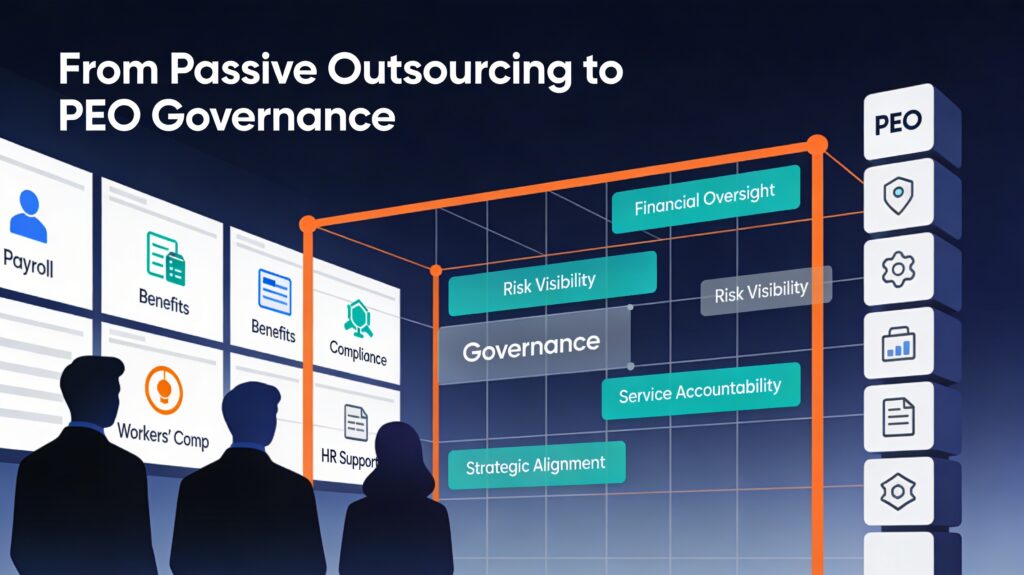
A PEO relationship should not operate on autopilot.
- But in most small and mid-size businesses, it does.
- From the day onboarding ends until the day the renewal invoice arrives.
After 37 years advising local and regional businesses, we have observed something consistent. Business owners evaluate PEOs carefully when they enter the relationship. They compare proposals. They negotiate terms. They ask hard questions about cost structure, compliance coverage, and service levels.
Then the contract is signed. Onboarding is completed. Payroll begins to run.
And the oversight stops.
A PEO is not simply a vendor. It is a co-employment structure. The PEO becomes the employer of record for tax and benefits purposes. It assumes specific responsibilities for payroll processing, regulatory compliance, workers’ compensation administration, and employee benefits management. That level of operational integration demands more than a handshake and an annual renewal review.
Co-employment without governance creates drift — financially, operationally, and strategically.
Defining Governance in a Co-Employment Model
In a PEO structure, governance is not about control. It is not about micromanaging the service provider or second-guessing every administrative decision. Governance is about maintaining structured visibility into a relationship that touches nearly every operational and financial dimension of the business.
- Clarity of responsibility between employer and PEO
- Ongoing financial oversight of invoices, fees, and cost allocation
- Risk visibility across workers’ compensation, compliance, and regulatory exposure
- Strategic alignment between the PEO model and the company’s growth trajectory
- Early detection of misalignment before it becomes a financial event
Here is the working definition we use with clients:
PEO governance is the structured oversight system that ensures the co-employment relationship continues to support the company’s financial model, workforce strategy, compliance posture, and operational needs.
Without governance, the relationship slowly shifts from strategic support to embedded cost center. The business owner may not notice the drift for months or even years. But the financial impact compounds quietly in the background.
Why SMBs Rarely Govern the Relationship
Most businesses enter a PEO relationship for sound, practical reasons. They want administrative relief from the burden of payroll processing and tax filings. They want access to better benefits packages that they could not secure independently. They need workers’ compensation management, HR compliance support, and the infrastructure to hire across multiple states.
These are legitimate motivations. The problem is not why the relationship begins. The problem is what happens after onboarding is complete.
- Reviews happen only at renewal — twelve months of unexamined invoices
- Invoices are paid, not dissected
- Claims are reported, not analyzed for patterns
- Service teams change without executive discussion
- The company’s strategic direction evolves — but the PEO model stays frozen
- Benefits plans renew on default settings rather than intentional selection
Each of these gaps feels minor in isolation. Collectively, they represent the absence of a governance discipline.
That is not governance. That is passive outsourcing.
And passive outsourcing is where hidden costs accumulate, compliance gaps emerge, and strategic misalignment takes root.
The Risk of Non-Governed Co-Employment
When governance is missing from a co-employment relationship, the consequences do not arrive as a single crisis. They accumulate. They compound. And they remain invisible to leadership until a triggering event forces them into view.
Three patterns emerge consistently in businesses that operate PEO relationships without structured oversight.
Costs Drift Upward Without Revenue Alignment
Administrative fees increase incrementally. Benefits costs adjust annually based on claims history and carrier pricing, not employer strategy. Workers’ compensation rates shift with experience modification factors that few business owners monitor. Over time, the cost of the PEO relationship grows at a rate disconnected from the company’s revenue trajectory. Without quarterly financial review, this drift is invisible until the renewal proposal arrives.
Risk Exposure Shifts Without Leadership Awareness
Regulatory environments change. Employment law evolves at both the federal and state level. The company’s workforce composition shifts as it adds employees in new jurisdictions, reclassifies workers, or expands into new operational models. Each of these changes alters the risk profile of the co-employment arrangement. Without governance, leadership does not fully understand how exposure has shifted since the relationship was originally structured.
The HR Structure Stops Matching the Company’s Growth Strategy
A PEO model that was appropriate for a 35-person company may not serve a 120-person company with multi-state operations, specialized compliance requirements, and a more sophisticated talent retention strategy. But because nothing visibly breaks in the interim, leadership assumes the model is still working.
A CFO can track payroll expense to the penny. But no spreadsheet captures the compounding cost of unexamined fees, unreported risk shifts, or a benefits structure that no longer supports the company’s talent objectives.
And because nothing “breaks,” leadership assumes everything is fine.
Until renewal shock. Or a claims spike. Or expansion hits friction that no one anticipated.
The Core Problem Is Not Information. It Is Discipline.
Most PEOs provide reporting. Most provide access to dashboards, claims data, and invoice detail. The information exists. What does not exist — in the vast majority of small and mid-size businesses — is a structured discipline for reviewing that information on a regular cadence, interpreting it in context, and acting on it before the consequences materialize.
Governance is not a product. It is not a platform. It is a practice.
And it is the practice most SMBs have never built into their PEO relationship.
Learn More at PEOAdvisor.com
The sooner governance is introduced, the smaller the correction. Ignore it long enough, and the PEO relationship becomes an unexamined cost center embedded at the core of your operations.
Coming Next: In the next post in this series, we will break down the six governance domains every SMB should monitor in a PEO relationship — from financial oversight and compliance review to service accountability and strategic alignment.
- How do I actually implement PEO governance in a small or mid-size business? Set a simple cadence and stick to it: do a light monthly check of invoices and headcount, a quarterly working session (finance + HR + PEO) to review total costs, claims, and fit with your growth plan, and an annual pre-renewal review that treats the PEO like any major vendor—testing fees, structure, and options before you sign.
- How can I tell if my current PEO relationship is drifting or misaligned? Look for cost growth outpacing revenue, unexplained fee or tax changes, added states or roles without a compliance discussion, rising service friction, and a PEO setup that looks exactly the same even though your headcount, locations, and talent strategy have changed materially.
- What are the key PEO governance domains, and where should I start? Focus first on financial oversight and compliance—tracking all PEO costs quarterly and clarifying who owns which risks—then layer in workers’ comp and benefits strategy, payroll taxes and cut-off rules, and finally service accountability and strategic alignment as part of your regular annual planning.
Independent CPA-Led Advisory | Helping Employers Find the Right PEO Partner | 37 Years of Experience
#PEO #PEOGovernance #CoEmployment #HRStrategy #SmallBusiness #CPAAdvisory #EmployerProtection