
Two dollars can sit side by side in the same Trump Account. One will be taxed when it is withdrawn. The other will not. The account does not separate them — the balance shows a single number — but the tax is decided long before the withdrawal, by where each dollar came from.
In our advisory practice, this is the part of the Trump Account the headlines never reach. Coverage has focused on the $1,000 seed and the $5,000 annual limit. It has not focused on basis — the record that determines whether a withdrawal returns tax-free or gets taxed as ordinary income, and in some cases taxed a second time on money that was already taxed once.
This is the third post in our series on the Trump Account under Internal Revenue Code Section 530A. The first article covered what the account is and how it is opened; the second examined the employer’s Section 128 contribution. Here, we walk through the five sources that can fund a Trump Account, how each one is taxed, and why the family that tracks its own contributions is the family that keeps them.
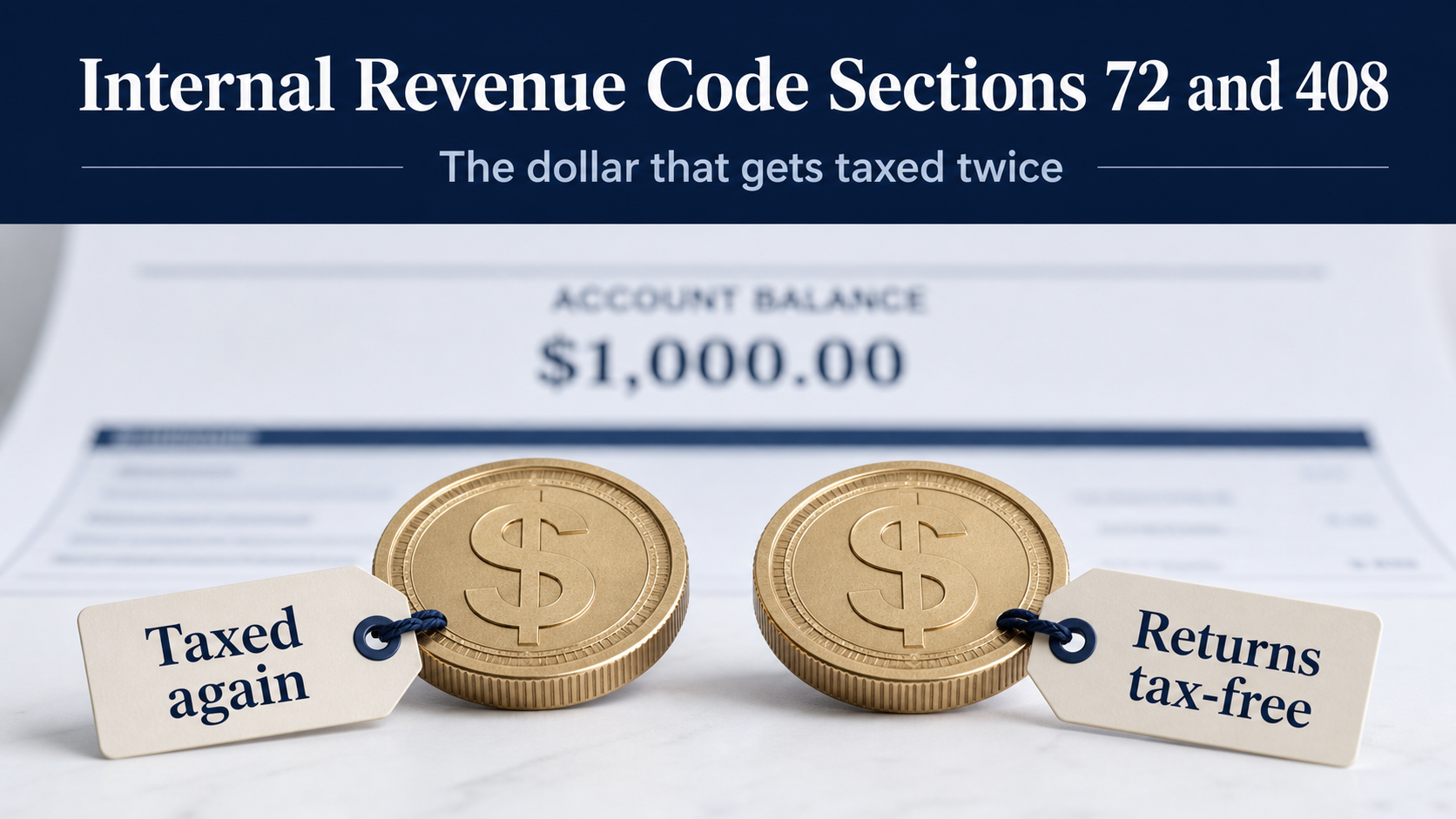
The Five Sources of a Trump Account
Money can enter a Trump Account from five directions, and they do not arrive on equal terms.
| Source | What it is |
|---|---|
| The federal seed | A one-time $1,000 pilot contribution for eligible children born 2025–2028 |
| Qualified general contributions | Gifts from governments or 501(c)(3) charities to a qualified class of beneficiaries |
| Section 128 employer contributions | Up to $2,500 per employee through a written employer contribution program |
| Family and individual contributions | After-tax gifts from the child, parents, family, or friends, within the $5,000 limit |
| Qualified rollovers | Transfers from a prior Trump Account that carry their history with them |
Three of these sources are funded with dollars that were never taxed. One is funded with dollars that were already taxed. The fifth simply carries its history forward.
Basis Is the Line That Decides the Tax
Basis is the amount of after-tax money in the account. It matters for one reason: the beneficiary is never taxed again on basis when it is withdrawn. Everything else is taxed as ordinary income.
| Source | Creates basis? | Taxed at withdrawal? |
|---|---|---|
| Federal seed | No | Yes, in full |
| Qualified general contributions | No | Yes, in full |
| Section 128 employer contributions | No | Yes, in full |
| Family and individual contributions | Yes | Only the earnings |
| Qualified rollovers | Carries prior basis | Depends on basis carried |
This is the basis point we flagged in the employer article. The employer’s $2,500 contribution is tax-free going in, which means it was never taxed — which means it is fully taxed coming out. A parent’s contribution is made with after-tax dollars, so the contribution itself returns tax-free and only the growth is taxed. Same account. Opposite outcomes.
How the Tax Is Actually Calculated
When a distribution is taken after the child turns eighteen, the Trump Account follows traditional IRA rules. The tax is not all-or-nothing — each withdrawal is part basis and part earnings, in proportion to the account.
Consider an account worth $40,000, of which $4,000 is basis.
- → Ten percent of the account is basis.
- → Ten percent of any withdrawal returns tax-free.
- → Ninety percent is taxed as ordinary income.
Two rules sharpen this picture. The Trump Account stands alone — it is never blended with the beneficiary’s other individual retirement accounts for this calculation. And a withdrawal before age 59½ generally carries an additional 10 percent tax on the taxable portion, unless an exception applies.
Before Eighteen, and After
During the growth period, which runs until the end of the year before the child turns eighteen, the account is largely locked. Distributions are generally not permitted, with narrow exceptions for rollovers, an ABLE transfer at seventeen, the return of excess contributions, and death.
On January 1 of the year the child turns eighteen, the special rules end. The account becomes an ordinary traditional IRA, with all the planning that implies, including conversions and required distributions. We follow the account there in the final article of this series.

Why the Records Matter More Than the Balance
Here is the quiet risk. The account reports a balance. It does not report basis. If no one tracks which dollars were after-tax, the family can pay tax a second time on money that was already taxed once. The contribution that should have returned tax-free becomes a taxable distribution, simply because the record was never kept as part of ongoing tax planning.
Regulatory status: Distributions are governed by the traditional IRA rules under Sections 72 and 408, and the Treasury and the IRS have signaled that additional guidance on this tax treatment is still to come. Basis must be tracked for the Trump Account on its own, separate from any other individual retirement account. Records of every contribution and its source are the difference between a tax-free return of basis and an avoidable tax bill.
For families who want a system to actually track this — not just this account, but how it fits alongside 529 plans, custodial accounts, and the rest of a child’s financial picture — our affiliate, Balanced Wealth Strategies, helps families build that record-keeping into a broader wealth plan.

The Point Most Will Miss
The tax is not set by the account. It is set by the source. The account remembers the balance. It does not remember the basis. Someone must.
The work is not to fund the account. It is to document it.
- → Families that track basis withdraw their own contributions tax-free.
- → Families that do not will pay tax twice on the same dollars.
A dollar saved is not always a dollar kept. What is kept depends on what was recorded.
This is the third article in our Trump Accounts series. The final article follows the account to age eighteen and beyond: accumulation, the transfer of control, the compliance risks, and the economic value that survives the tax.
37 years advising employers. Independent, employer-side perspective. Any compensation fully disclosed. If your family or your business is weighing how to track contributions to a Trump Account — or how the account fits into a broader tax and wealth plan — we welcome the conversation. Contact our office to discuss how Sections 72 and 408 apply to your situation.
Regulatory references: One Big Beautiful Bill Act (Pub. L. 119-21); IRC Sections 530A, 128, 6434, 72, and 408(d); IRS Notice 2025-68; IRS Form 4547 instructions; IRS Publication 590-B (taxation of traditional IRA distributions and basis). Tax-treatment guidance remains in development as of June 2026.
Trump Account Basis and Taxation FAQ

- What is basis in a Trump Account? Basis is the after-tax portion of the money in the account. When the beneficiary later withdraws funds, basis returns tax-free; everything else, including the federal seed, employer contributions, and earnings, is taxed as ordinary income. Tracking basis is the difference between a tax-free return of contributions and paying tax a second time on money already taxed.
- Which Trump Account contributions create basis? Only family and individual after-tax contributions create basis, since that money was already taxed before it went into the account. The $1,000 federal seed, qualified general contributions from governments or charities, and Section 128 employer contributions do not create basis, because none of those dollars were taxed before they were deposited.
- How is a Trump Account distribution taxed after the child turns 18? Once the child turns eighteen, the Trump Account follows traditional IRA distribution rules. Each withdrawal is part basis and part earnings, in the same proportion as the account overall — so if 10 percent of the account is basis, 10 percent of any withdrawal returns tax-free and the remaining 90 percent is taxed as ordinary income.
- Is the $2,500 Section 128 employer contribution taxed when withdrawn? Yes, in full. Because the employer’s $2,500 contribution was excluded from the employee’s income going in, it was never taxed, so it does not create basis. When it is eventually withdrawn, that entire amount is taxed as ordinary income, unlike an after-tax family contribution of the same size.
- Does a Trump Account withdrawal before age 59½ get taxed differently? The ordinary-income tax on the earnings and non-basis portion applies regardless of age, but a withdrawal taken before age 59½ generally triggers an additional 10 percent tax on the taxable portion, unless a specific exception applies. This mirrors the early-withdrawal penalty on a traditional IRA.
- Is a Trump Account combined with the beneficiary’s other IRAs for basis calculations? No. The Trump Account stands alone for this purpose. It is never blended with the beneficiary’s other individual retirement accounts when calculating the basis percentage of a distribution, so its basis must be tracked separately from any other IRA the same person owns.
- Why does record-keeping matter more than the account balance? The account statement shows only a single balance; it does not show which dollars were already taxed. Without a record of every contribution and its source, a family can end up paying tax a second time on money that was already after-tax, turning what should have been a tax-free return of basis into an avoidable tax bill.
This article provides general information about Trump Account basis and taxation strategies and should not be construed as specific tax advice. Tax laws are complex and subject to change. Individual circumstances vary significantly, and what works for one taxpayer may not be appropriate for another. We recommend working with qualified tax and financial advisors to develop a strategy tailored to your specific situation. This content does not constitute an offer of advisory services and is provided for informational purposes only.