
PEO Governance: The Missing Discipline in Co-Employment Relationships
Post 5 of the PEO Governance Series | Final Post
Every framework needs someone to run it; A CPA PEO Advisor.
- → Not who should do it in theory.
- → Who has the objectivity, the financial expertise, and the independence to do it well.
Every post in this series has built toward one question. We established that most businesses stop governing their PEO relationship after on-boarding. We identified the six domains where governance must live. We delivered a practical monitoring system with quarterly dashboards, traffic light scoring, and escalation triggers. We catalogued the twelve warning signs that signal drift before leadership recognizes it.
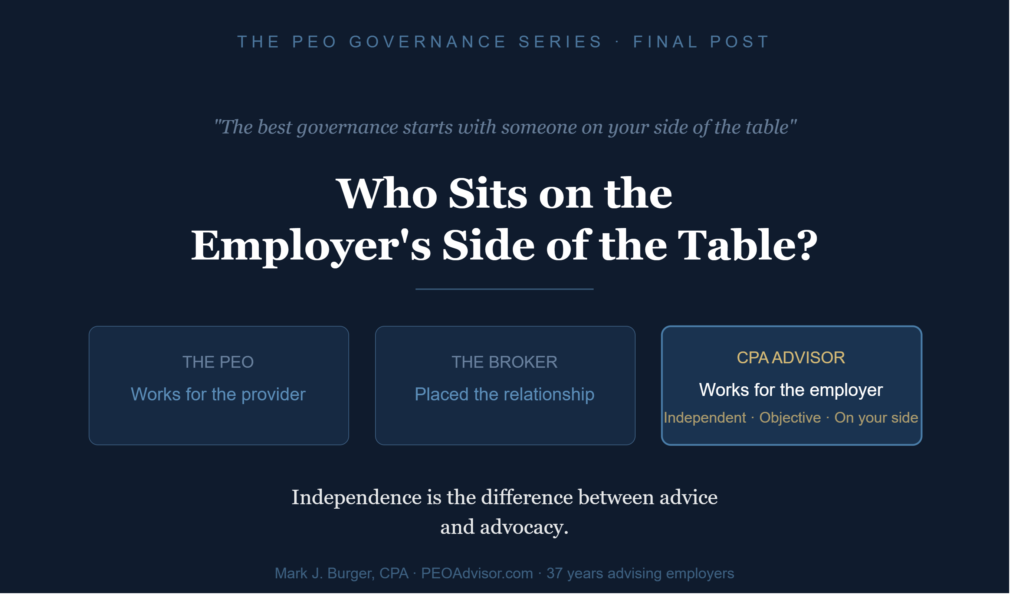
But throughout this series, one question has been present beneath every framework, every dashboard, and every warning sign:
Who is actually going to do this?
The PEO will not govern itself. It is the service provider. The broker who placed the PEO has a financial relationship with the provider. Internal HR may lack the financial depth. The CFO may lack the co-employment expertise. And the business owner is focused on running the business.
This is the gap an independent CPA advisor fills. Not as a replacement for any of these roles — but as the objective, financially trained professional who sits on the employer’s side of the table and ensures the co-employment relationship continues to serve the company rather than the other way around.
The Information Asymmetry Problem
A PEO relationship operates with a structural information asymmetry that most business owners never fully recognize.
The PEO understands its own cost structure, fee composition, claims experience, carrier pricing, and administrative margins. It knows precisely how its profit model works. The client, by contrast, receives a composite invoice, an annual renewal proposal, and periodic reports that may or may not provide the granularity needed to make informed decisions.
- → The PEO knows what it costs to serve you. You do not.
- → The PEO knows how your claims history compares to its broader pool. You do not.
- → The PEO knows whether your renewal increase is driven by your experience or by portfolio-level repricing. You do not.
- → The PEO knows what margin it earns on your benefits. You do not.
This asymmetry is not malicious. It is structural. PEOs are businesses with their own financial objectives. But it means that the employer enters every financial conversation — especially renewal — at an informational disadvantage.
Industry data confirms the scope of this gap. PEO administrative fees range from $40 to $160 per employee per month, or two to six percent of payroll. But the quoted rate is rarely the actual cost. Hidden charges for off-cycle payroll runs, COBRA administration, year-end processing, and termination penalties compound across a year. Some PEOs apply a markup of five to twenty percent on health insurance premiums — and that markup is rarely transparent. Without independent financial analysis, the employer has no way to distinguish between a cost increase driven by legitimate claims experience and one driven by provider-side margin expansion.
An independent CPA advisor eliminates that asymmetry.
Five Governance Functions a CPA Advisor Delivers
A CPA advisor does not replace the PEO, the broker, or internal leadership. The role is distinct: provide the independent, employer-side financial and strategic analysis that no other party in the relationship is positioned to deliver.
1. Objective Financial Analysis
The CPA advisor dissects the PEO invoice at the component level — administrative fees, benefits costs, workers’ compensation premiums, payroll taxes, and technology charges — and tracks each component over time against the company’s revenue, headcount, and claims history.
This is the Financial Dashboard from the governance framework, populated and interpreted by a professional whose training is specifically designed for this analysis. A CPA reads financial data the way a physician reads diagnostic imaging. The patterns that are invisible to the untrained eye are immediately apparent to someone who has been analyzing these structures for decades.
- → Invoice reconciliation at the component level, not the total.
- → Cost trend analysis across quarters, not just year-over-year.
- → Workers’ compensation experience modification tracking and interpretation.
- → Benefits cost benchmarking against market alternatives.
- → Renewal proposal modeling before negotiation begins.
NAPEO research indicates that the return on investment when a business uses a PEO averages 27 percent in cost savings alone, with companies saving approximately $1,775 per employee annually. But those savings are only realized when the relationship is actively monitored. Without independent financial analysis, the savings erode invisibly through fee accumulation, unexamined renewals, and cost drift that no one detected.
2. Compliance Oversight and Regulatory Monitoring
A PEO assumes certain compliance responsibilities. But the employer retains ultimate accountability for its workforce. When regulatory requirements change — and they are changing at an accelerated pace in 2026 — someone needs to verify that the PEO is implementing those changes correctly, completely, and on time.
A CPA advisor monitors the regulatory landscape and cross-references it against the PEO’s execution. This is not about duplicating the PEO’s compliance function. It is about verifying it independently.
2026 Context: The 2025-2026 regulatory environment has created an unusually dense wave of compliance obligations that directly impact PEO operations. The One Big Beautiful Bill Act introduced new payroll withholding mechanics for tips and overtime effective January 1, 2026. Secure 2.0 mandates Roth-only catch-up contributions for highly compensated employees, with IRS proposed regulations specifically addressing the Certified PEO relationship. Paid family and medical leave programs have now been enacted in 14 jurisdictions, with Oregon’s HB 2236 creating new PEO client-by-client state tax reporting elections. IRS Revenue Ruling 2025-4 reclassified employer pickup contributions of PFML premiums as wages subject to federal income and employment taxes. Multiple states have enacted laws regulating AI in employment decisions. OSHA serious violation penalties now reach $16,550, with willful violations at $165,514. Each of these changes creates new processing requirements, new reporting obligations, and new points of potential failure. A CPA advisor ensures that no regulatory change falls through the gap between what the PEO promises and what it delivers.
3. Strategic Alignment Counsel
A PEO model that was appropriate for a 40-person, single-state company may not serve a 150-person company expanding into five states with an acquisition on the horizon. But the PEO is unlikely to tell you that — because the PEO’s incentive is to retain the client, not to recommend a transition.
A CPA advisor evaluates the PEO relationship against the company’s actual growth trajectory and strategic direction. This includes assessing whether the benefits offering is competitive in the labor markets where the company recruits, whether the PEO’s multi-state infrastructure matches the company’s expansion plans, and whether the co-employment model still makes financial sense at the company’s current scale.
- → Benefits competitiveness analysis against the company’s specific labor market.
- → Multi-state compliance capability assessment.
- → Scale evaluation: when does bringing HR in-house become the better financial decision?
- → Acquisition integration analysis: does the PEO model support or complicate deal execution?
NAPEO data shows that businesses using a PEO grow at more than double the rate of comparable non-PEO companies and are 50 percent less likely to go out of business. But those outcomes depend on the PEO model remaining aligned with the company’s evolution. A CPA advisor is the independent voice that tests that alignment quarterly, without a financial incentive to preserve the status quo.
4. Renewal Negotiation Support
Renewal is the single highest-leverage moment in a PEO relationship. It is also the moment where the information asymmetry is most acute. The PEO arrives with a fully modeled proposal. The client, in most cases, arrives with twelve months of unexamined invoices and no independent data.
A CPA advisor changes that dynamic entirely.
- → Twelve months of tracked cost components, analyzed and benchmarked.
- → Claims trend data interpreted independently of the PEO’s narrative.
- → Workers’ compensation experience modification analysis with historical context.
- → Market benchmarking against alternative providers and pricing models.
- → Negotiation positioning based on data, not assumptions.
When a business owner walks into a renewal conversation with independent financial analysis prepared by a CPA, the negotiation shifts from “accept or reject” to “explain and justify.” That shift is where hidden costs are surfaced, unjustified increases are challenged, and better terms are secured.
The companies that accept renewal increases without modeling forfeit leverage they can never recover. The companies that bring independent financial analysis to the table retain it.
5. Exit Readiness and Contingency Planning
No PEO relationship should be assumed permanent. A CPA advisor ensures that the option to exit remains viable at all times — not because the goal is to leave, but because the ability to leave is the foundation of negotiating leverage.
- → Contract termination provision review and financial impact modeling.
- → Data portability assessment: can the company access and own all employee records, payroll history, and compliance documentation?
- → Transition cost analysis: what would it cost to bring HR operations in-house or move to an alternative provider?
- → Contingency planning: what happens if the PEO experiences financial distress or regulatory action?
A PEO relationship where the client cannot exit without significant operational disruption is not a partnership. It is a dependency. A CPA advisor ensures that governance includes exit readiness as a standing item — reviewed quarterly, documented, and available the moment a strategic decision requires it.
Why Independence Matters More Than Expertise Alone
Financial expertise is available from many sources. The PEO has financial analysts. The broker has consultants. The company may have a CFO or controller. The differentiator is not expertise. It is independence.
- → The PEO’s financial team works for the PEO.
- → The broker earns revenue from the PEO placement.
- → Internal leadership may lack co-employment-specific expertise.
- → An independent CPA advisor works for the employer. Period.
Independence means the analysis is not influenced by the provider’s retention objectives, the broker’s placement incentives, or internal politics that might discourage asking difficult questions about a relationship that touches every employee in the organization.
As one CPA who spent ten years as the CFO of a PEO described it: CPAs are a business’s trusted advisors. They are usually the first call a CEO makes when there is an issue. That trust is earned through independence, credentialed authority, and a fiduciary orientation that puts the client’s interest first.
The Advisory Fee: How It Works
Transparency about compensation is part of governance. In our advisory model, the fee is paid by the PEO through a broker relationship — not by the client.
This means the employer receives independent, CPA-level governance counsel at no direct cost. The advisory fee does not increase the client’s PEO pricing, does not reduce the scope of services, and does not create a financial conflict between the advisor and the employer.
Our advisory fee is paid by the PEO through a broker relationship. It does not impact the client’s cost structure, service level, or solution design. The employer receives independent governance counsel without adding a line item to the budget.
This model exists because PEOs recognize that well-governed relationships last longer, generate fewer disputes, and produce better outcomes for both parties. An employer with independent financial oversight is a better client — more informed, more engaged, and more likely to maintain the relationship when it is performing well.
The result is an alignment of interests that benefits the employer, the PEO, and the advisory relationship simultaneously.
The Business Case for Governed PEO Relationships
The data is unambiguous. PEO relationships deliver measurable value when they are properly structured and actively managed.
- → Businesses using a PEO grow at more than double the rate of comparable non-PEO companies.
- → Employee turnover is 12 percent lower for PEO clients.
- → PEO clients are 50 percent less likely to go out of business.
- → The average return on investment is 27 percent in cost savings alone.
- → Companies save approximately $1,775 per employee annually.
- → PEO clients report 16 percent higher profitability.
These are not aspirational projections. They are measured outcomes from NAPEO research spanning more than 15,000 businesses. But they are outcomes that depend on active management, not passive outsourcing.
A PEO that is governed delivers compounding value. A PEO that is not governed delivers compounding hidden cost. The difference between the two is not the PEO. It is the presence or absence of independent oversight.
Closing the Series: From Discipline to Practice
This series began with a simple observation: most businesses stop governing their PEO relationship the moment on-boarding is complete. Five posts later, the framework for changing that pattern is complete.
- → Post 1 established that co-employment without governance creates financial, operational, and strategic drift.
- → Post 2 identified the six governance domains where oversight must live.
- → Post 3 delivered the PEO Alignment Monitoring System — a practical framework with quarterly dashboards, traffic light scoring, and escalation triggers.
- → Post 4 catalogued the twelve early warning signs that signal drift before leadership recognizes it.
- → This final post answered the question that drives everything else: who provides the independent, employer-side governance that makes the entire system function.
The answer is an independent CPA advisor.
Not because the PEO is adversarial. Not because the broker lacks value. Not because internal leadership is insufficient. But because governance requires objectivity, financial depth, and independence — and no other party in the co-employment relationship brings all three to the employer’s side of the table.
The most successful PEO relationships are not the ones with the best contract, the lowest fee, or the most comprehensive service offering. They are the ones with the best governance. And the best governance starts with someone on your side of the table who has no reason to tell you anything other than the truth.
Catch up on the full series:
- PEO Governance: The Hidden Discipline That Protects Your Bottom Line
- Six PEO Governance Gaps Unmasked — And the Proven Framework to Eliminate Them
- Bulletproof Your PEO: The Proven Governance Blueprint for Smart Employers
- 12 Devastating PEO Warning Signs Most Employers Never Detect
37 years advising employers. Independent perspective. Our advisory fee is paid by the PEO — not by you. Schedule your governance review: PEOAdvisor.com/assessment
Learn more about Mark J. Burger, CPA
Independent CPA-Led Advisory | Helping Employers Find the Right PEO Partner | 37 Years of Experience | Our Fee Never Impacts Your Solution
#PEO #PEOGovernance #CoEmployment #HRStrategy #SmallBusiness #CPAAdvisory #EmployerProtection #IndependentAdvisor #PEORenewal #PEOCompliance
- What does a CPA governance review actually look like in practice — and how much of my time does it require? A governance review begins with building the Original Intent Document and populating the three quarterly dashboards — Financial, Risk, and Operational. The CPA advisor handles the data collection, analysis, and interpretation. Your involvement is one quarterly meeting where findings are reviewed, domains are scored, and action items are assigned. Most clients invest two to three hours per quarter in direct participation. The advisor invests significantly more behind the scenes. Results from the first review are immediate — most businesses identify at least two governance gaps that are already costing money. The system builds on itself. Each quarter produces clearer data, sharper benchmarks, and stronger positioning for renewal.
- If the advisory fee is paid by the PEO, how do I know the advice is truly independent — and what happens if the advisor recommends leaving? Independence is maintained because our obligation is to the employer, not the PEO. If the governance data indicates the relationship is no longer serving the company, we recommend transition — even though it ends the commission. We have done this. A CPA’s professional and ethical obligations run to the client, not the revenue source. The advisory fee structure exists because PEOs recognize that well-governed clients produce better long-term relationships. But when the data says it is time to move, we say it is time to move. That is what independence means in practice, not just in positioning.
- We have been with our PEO for several years without governance. Is it too late to start, or has the damage already been done? It is never too late. Governance can be introduced at any point in the relationship. The first quarterly review will surface the most urgent issues — typically in financial governance and risk exposure. Some drift can be corrected immediately through invoice reconciliation and renewal negotiation. Other gaps require two to three quarters of structured oversight to fully address. The critical point is that every quarter without governance is a quarter where cost drift compounds and leverage erodes. The correction is always smaller the sooner it begins. Start with the Original Intent Document. Schedule the first quarterly review. Request the data. The system begins producing value from the first meeting.